Smart Building Tech Trends for 2026: IoT, AI, Digital Twins, and What Comes Next
Smart buildings are entering a more accountable era. In 2026, the conversation is no longer about whether to invest in smart technology, but how to do it in a way that delivers measurable operational value, improves tenant experience, and reduces long-term risk.
IoT sensors, AI-driven analytics, digital twins, and connected platforms are all maturing, but not at the same pace, and not always in ways that justify their cost. For building owners, operators, and technology decision-makers, the challenge is separating genuine progress from noise and understanding which investments actually move the needle.
This ebook breaks down the smart building tech trends shaping 2026, with a practical lens. For each major trend, we explore what it is, why it’s gaining traction, where it shows up in real buildings, what to prioritize first, and how to measure success, so technology decisions can be made with clarity and confidence.
What Counts as Smart Building Tech Today
Smart building technology is best understood as a connected system, not a single upgrade or platform. Installing a new HVAC control, access system, or tenant app doesn’t make a building smart on its own. Intelligence emerges when systems share data, insights lead to action, and outcomes can be measured.
At a foundational level, modern smart buildings are built on five interconnected layers:
- Devices and sensors that capture signals such as occupancy, temperature, air quality, energy use, and equipment performance
- Connectivity that securely moves data between systems and locations
- Platforms that aggregate and normalize data across building technologies
- Analytics and AI that turn raw data into insights, predictions, and recommendations
- User experience layers that surface information to operators, tenants, and visitors through dashboards, apps, and in-building communication
What’s changed most in recent years is convergence. Building automation, IT, security, and proptech systems can no longer operate independently if organizations want scalable value. In 2026, successful smart building strategies are designed around interoperability, governance, and shared ownership across teams, not isolated tools.
The Forces Driving Smart Building Adoption
Several structural pressures are accelerating adoption and raising expectations for results.
Rising energy costs and decarbonization pressure
Energy volatility and sustainability commitments are pushing buildings to move beyond basic efficiency projects. Owners are expected not only to reduce consumption but to prove performance with credible data that supports ESG reporting and long-term planning.
Tenant expectations for comfort, convenience, and communication
Tenants increasingly evaluate buildings based on experience, not just location or amenities. Comfort, air quality, seamless access, and timely communication now play a direct role in satisfaction, retention, and perceived value.
Security and risk management (physical and cyber)
As buildings connect more devices and systems, the lines between physical security and cybersecurity continue to blur. Risk management now includes vendor access controls, network segmentation, and ongoing monitoring, not just cameras and credentials.
Operational efficiency and staffing constraints
Facilities teams are being asked to do more with less. Automation, predictive maintenance, and decision-support tools are no longer optional; they’re critical for maintaining performance without increasing headcount.
Top Smart Building Tech Trends for 2026
Before diving deeper, the table below provides a high-level view of the major trends shaping smart buildings in 2026, who typically owns them, and how success is measured.
| Trend | What It Enables | Who Owns It | KPI Examples | Common Pitfalls |
| IoT sensor expansion & fusion | Decision-grade visibility | Facilities / IT | Utilization accuracy, IAQ | Noisy data |
| AI & building analytics | Predictive operations | Facilities / Ops | Downtime reduction | Black-box models |
| Digital twins | Performance simulation | Engineering / Ops | Verified ROI | Overbuilt models |
| Smart HVAC & IAQ | Comfort as a service | Facilities | Complaints, CO₂ | Static controls |
| Smart access & security | Safer, flexible movement | Security / IT | Incident rates | Privacy gaps |
| Energy & ESG software | Verifiable sustainability | Facilities / Finance | kWh, emissions | Manual reporting |
| Tenant experience platforms | Engagement & retention | Property / Marketing | Adoption rates | Fragmentation |
| In-building digital signage | Visibility & communication | Property / Marketing | Recall, actions | Treating screens as static |
IoT Sensor Expansion and Sensor Fusion
IoT has been part of the smart building conversation for years, but in 2026, the shift isn’t about adding more sensors. It’s about making sense of the signals buildings already generate. Early deployments focused on isolated data points. Today, value is coming from sensor fusion, where multiple inputs are combined to create reliable, decision-grade insight.
This matters because operators need context, not just readings. Knowing a room is occupied is less useful than understanding how long it’s used, under what conditions, and how that usage affects energy and comfort.
In practice, this trend shows up in areas like:
- Occupancy-driven HVAC and lighting schedules
- Indoor air quality monitoring tied to ventilation response
- Equipment health tracking that flags early signs of failure
The priority for 2026 is not sensor volume, but data trust and governance. Buildings that deploy sensors without clear standards often end up overwhelmed by noise rather than empowered by insight.
KPIs to watch: IAQ time-in-range, reduction in after-hours runtime, utilization accuracy, and fewer reactive maintenance events.
AI and Building Analytics Become Operational, Not Experimental
AI is moving out of pilot mode and into day-to-day operations. The focus has shifted from experimentation to tools that actually reduce workload and prevent failures.
Where AI delivers the most value is in repetitive, high-impact tasks—detecting faults, identifying inefficiencies, and prioritizing issues that matter most. Where it still disappoints is when outputs aren’t explainable or actionable.
Common operational use cases include:
- Automated fault detection and diagnostics
- Predictive maintenance alerts
- Continuous energy optimization
The most successful deployments prioritize trust and workflow integration. Insights that don’t connect to work orders or operational processes rarely lead to savings.
KPIs to watch: Reduced downtime, faster issue resolution, maintenance cost savings, energy intensity improvements.
Digital Twins Shift From Visualization to Performance
Digital twins are evolving from static visual models into tools that help teams test, simulate, and validate decisions before committing capital.
They are most valuable when the stakes are high, like major retrofits, airflow rebalancing, or large energy projects. In those cases, simulation reduces risk and improves confidence. For simpler needs, traditional analytics may deliver better ROI with less complexity.
Effective use cases include:
- Retrofit and renovation planning
- HVAC optimization and commissioning
- Portfolio-level scenario analysis
The key is restraint. A digital twin should exist to answer a specific question, not because the technology is available.
KPIs to watch: Accuracy of predicted outcomes, avoided costs, verified energy savings.
Smart HVAC and Indoor Air Quality as a Tenant Experience Lever
HVAC and IAQ systems are no longer purely operational tools; they’re increasingly tied to how tenants perceive a building. Comfort, health, and transparency have become experience differentiators.
Smart HVAC strategies now focus on:
- Demand-controlled ventilation
- Advanced filtration with performance tracking
- Zone-level comfort adjustments
The most effective programs pair performance with communication, helping tenants understand what the building is doing and why it matters.
KPIs to watch: Complaint volume, IAQ consistency, satisfaction scores, retention indicators.
Smart Access Control and Building Security Convergence
Access control systems are becoming more flexible and more connected, supporting mobile credentials, visitor management, and richer audit trails. At the same time, cybersecurity considerations are becoming unavoidable.
Modern deployments balance convenience with control by focusing on:
- Privacy-first credential design
- Vendor access governance
- Network segmentation and monitoring
KPIs to watch: Incident reduction, access efficiency, audit readiness, system uptime.
Energy Management Software and ESG Reporting Maturity
Energy management tools are shifting from optimization engines to proof engines. The goal is no longer just efficiency, but defensible, repeatable reporting.
Mature programs emphasize:
- Automated data collection and validation
- Clear measurement boundaries
- Reduced reliance on manual reporting
KPIs to watch: Energy reduction, peak demand control, reporting cycle time, and audit success.
Tenant Experience Platforms Consolidate
Tenant experience tools are evolving from point apps into broader platforms that unify communication, services, and engagement. Adoption and sustained use, not feature count, define success.
Buildings seeing the most value focus on:
- Fewer, better-integrated tools
- Clear tenant value propositions
- Consistent visibility across touchpoints
KPIs to watch: Adoption rates, engagement frequency, satisfaction indicators.
In-Building Digital Signage as Smart Infrastructure
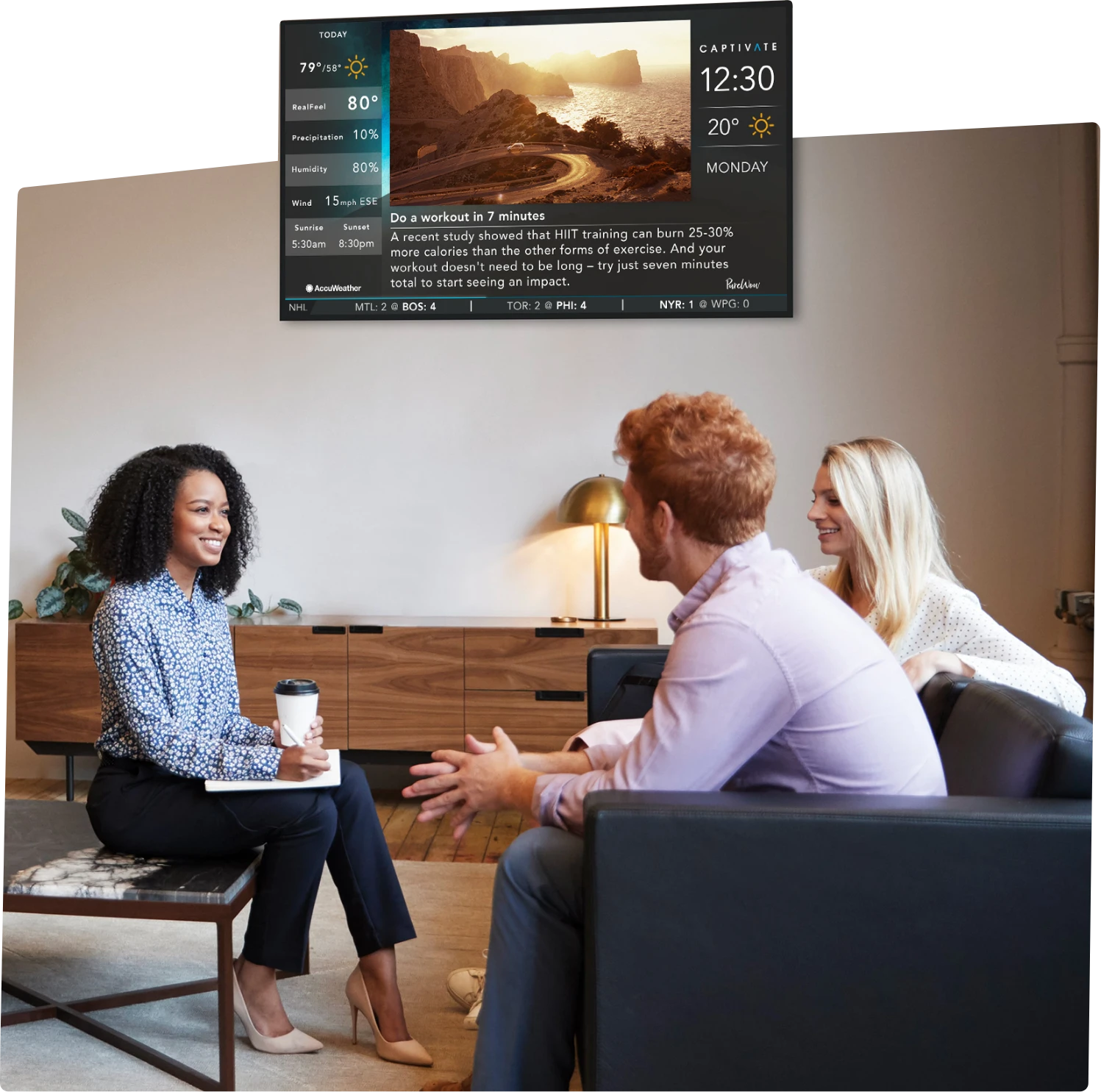
Digital signage has become a critical part of the smart building experience layer. Unlike apps or dashboards, screens reach people passively in shared spaces, making them highly effective for communication.
When integrated thoughtfully, digital screens support:
- Timely building updates and alerts
- Visibility for amenities and community programming
- Measurable engagement through QR codes and URLs
KPIs to watch: Message recall, engagement actions, and communication effectiveness.
What to Prioritize First (If You Can’t Do Everything)
Smart building roadmaps often fail not because the technology is wrong, but because teams try to do too much at once. In 2026, the most successful programs start small, focus on outcomes, and build momentum through visible wins.
If you can’t tackle everything at once, which is the reality for most organizations, a structured first 90 days can help align teams, reduce risk, and set a foundation for scale.
A Practical First 90 Days Roadmap
Day 1–30: Inventory and Reality Check
The first month is about understanding what you actually have, not what vendors promise or what documentation suggests.
Start by:
- Inventorying current systems and data sources (what exists, what’s connected, what’s trusted)
- Identifying owners across Facilities, IT, Security, and Operations
- Documenting vendor access methods and current cybersecurity posture
This step often surfaces redundancies, gaps, and risks that weren’t visible before. It also clarifies where governance and accountability need to be strengthened before adding new technology.
Day 31–60: Pick Measurable Outcomes
Once the landscape is clear, shift focus from tools to results. The goal is alignment, not perfection.
Key actions include:
- Choosing 3–5 KPIs that matter most (energy, uptime, work orders, complaints)
- Defining baseline performance so improvement can be measured
- Selecting one building or one subsystem to pilot
By narrowing the scope, teams can test assumptions and refine workflows without overwhelming operations.
Day 61–90: Pilot With Governance
The final phase turns insight into action. A pilot only delivers value if it’s governed and operationalized.
Priorities should include:
- Launching a pilot with clear success criteria
- Deciding data standards (naming conventions, tagging, retention)
- Building workflows so insights lead to action (alerts → triage → work order)
This is where many initiatives stall. Clear ownership and process design make the difference between insight and impact.
Quick Wins Versus Platform Bets
Not all smart building investments require long timelines to pay off. Some deliver fast, visible returns, while others are longer-term platform decisions.
Examples of Fast Payback Upgrades
Quick wins often focus on correcting inefficiencies that are already costing money:
- Fixing scheduling and after-hours runtime
- Targeted sensor deployment in complaint-heavy zones
- Fault Detection and Diagnostics (FDD) for the most expensive equipment classes
These improvements typically show results within months, not years.
When to Standardize on a Platform vs. Best-of-Breed
There’s no one-size-fits-all answer. The right choice depends on scale, governance needs, and integration maturity.
Standardize when:
- You need portfolio-wide consistency
- Reporting and benchmarking matter
- Shared governance and security are priorities
Keep best-of-breed when:
- A specialized solution materially outperforms alternatives
- It integrates cleanly via open APIs
- The operational value outweighs added complexity
Measurement and ROI: How to Prove Value
Smart building investments increasingly live or die by their ability to demonstrate ROI. That means agreeing upfront on what success looks like and how it will be measured.
Core KPI Categories
Most outcomes fall into four categories:
- Energy and cost: kWh reduction, peak demand, direct savings
- Operations: work orders, downtime, response time
- Experience: complaints, satisfaction, retention proxies
- Risk: incident reduction, compliance performance
Not every project needs to hit all four, but every project should clearly map to at least one.
Building a Simple ROI Model
A practical ROI model doesn’t need to be complex. It needs to be consistent.
Inputs:
- Baseline costs (energy, maintenance, downtime)
- Intervention costs (hardware, software, labor, training)
- Expected savings and time-to-value
Outputs:
- Payback period
- Annual savings
- Risk-adjusted ROI (including avoided failures and compliance risk)
A practical tip: treat experience ROI like operations ROI. Tie it to measurable proxies such as complaint reduction, faster communication, or increased participation in building programs.
Implications for Brands and In-Building Engagement
Smart buildings don’t just operate differently; they create different media environments.
Why Smarter Buildings Can Be More Measurable Environments
Smarter buildings often have:
- Predictable routines and repeated exposure opportunities
- More consistent tenant and visitor composition
- Clearer paths to action when the experience layer is designed intentionally
Tenant communication and in-building screens sit within that experience layer, helping buildings clearly communicate the investments they’re making, such as new amenities, services, and operational improvements, while increasing tenant awareness, satisfaction, and overall perception of the building.
What Measurable Outcomes Look Like for Real Estate
For real estate teams, success is measured by how effectively buildings communicate, support tenants, and reinforce long-term property value:
- Improved tenant satisfaction and perceived quality of the building
- Increased tenant awareness of amenities, services, and building improvements
- Higher engagement with building communications and updates
- Improved tenant satisfaction and perceived quality of the building
- Stronger relationships between tenants and property management
- Reduced reliance on email and printed notices for critical communication
Over time, these outcomes contribute directly to higher renewal rates, stronger tenant retention, increased demand from prospective tenants, and greater long-term property value across a portfolio.
Best Practices for Selecting Smart Building Tech Vendors
As systems become more interconnected, vendor selection becomes a strategic decision rather than a simple procurement exercise.
Key evaluation criteria include:
- Interoperability and integration requirements: demand open APIs, data exportability, and clear integration paths
- Security posture and support model: evaluate remote access controls, patch cadence, monitoring, and SLAs
- Data ownership and analytics transparency: avoid black-box systems that can’t be validated or migrated away from
- Pilot design and change management: insist on rollout plans that include training and operational workflows
Beyond technical capabilities, vendor accountability and support models matter. Buildings should prioritize partners with U.S.-based customer success teams that are easily accessible, secure, and offer encrypted connectivity that adheres to strict data protection standards, and a proven approach to cybersecurity, including regular audits and monitoring.
Long-term reliability, transparent operations, and the ability to evolve with a building’s strategy should outweigh short-term feature sets. The goal isn’t just to buy technology; it’s to ensure it can evolve with your building strategy.
FAQ
What is the biggest smart building trend right now?
The biggest trend is operationalization: moving from disconnected pilots to integrated systems that deliver measurable outcomes across energy, uptime, and experience with governance and security built in.
What technologies make a building smart?
A building becomes smart when it has a connected stack: sensors and devices, secure connectivity, integrated platforms, analytics and AI, and an experience layer that turns insights into action and communication.
How do IoT sensors improve building performance?
IoT sensors provide real-world signals (occupancy, air quality, temperature, and equipment health), allowing buildings to reduce wasted runtime, detect faults earlier, and tune comfort at the zone level.
What is a digital twin in a smart building?
A digital twin is a model that uses real data to simulate building or system behavior. It’s most valuable for testing scenarios, validating retrofit decisions, and proving performance improvements before investing.
How do I measure ROI for smart building investments?
Start with baseline costs and define KPIs across energy, operations, experience, and risk. Track improvements over time to calculate payback period and risk-adjusted ROI.
What are the cybersecurity risks in smart buildings?
Risks include unmanaged devices, flat networks, weak vendor access controls, and inconsistent patching. Segmentation, access policies, monitoring, and disciplined updates are essential.
How do smart buildings improve tenant experience?
They improve comfort, convenience, and communication. Experience improves most when performance is built and updates are made visible through consistent, high-visibility touchpoints.
How does in-building digital signage fit into a smart building strategy?
Digital signage is part of the experience layer—a high-visibility channel that improves communication, supports real-time messaging, and enables measurable engagement through actions like QR scans and URL visits.
Partnering With Captivate to Activate Smarter Buildings
Smart building investments matter most when people can actually see and feel the difference. While systems like HVAC, analytics, and access control do their work behind the scenes, communication and in-building media are where that investment shows up day to day.
Captivate helps bring the experience layer to life through in-building digital screens that make important information easily visible in lobbies, elevators, and shared spaces. Founded in 1997, Captivate brings nearly 30 years of industry leadership, a U.S.-based customer success team, and a secure, proven platform designed to support properties today while evolving with future building strategies.
For real estate owners and operators, smarter buildings create clearer, more accountable experience environments. When communication aligns with tenant routines and shared spaces, it becomes easier to reinforce building quality, highlight improvements, and ensure tenants are informed in the moments that matter most.
Ready to see what the experience layer can do?
Explore how Captivate’s in-building screens help properties communicate better and help brands connect with audiences in high-attention environments.
Would you like to extend the conversation?
Book a demo to learn more about impactful, engaging digital signage solutions from Captivate.